Time travel was supposed to be the breakthrough that changed life in America forever.
A cure for regret.
A shortcut to success.
A way to rewrite a life that felt messy, painful, or unfinished.
But no one expected this.
No one expected that stepping into the machine meant stepping out of your own mind.
This is a story—not just of science, but of people.
Of a country mesmerized by a dream… and shaken by its cost.
The Beginning: When America First Tasted the Future
The first time the world heard about ChronoShift Labs—an unassuming tech facility built in a quiet part of Nevada—the news cycle exploded.
Social media lit up.
Morning talk shows treated it like the moon landing of the 21st century.
Teenagers joked online about going back in time to prevent their parents from meeting.
Every investor in Silicon Valley nearly passed out with excitement.
But beneath the hype, something more personal was happening.
Americans—people who carried a lifetime of “what ifs”—felt hope waking inside them.
What if I could go back and take that job?
What if I could save that relationship?
What if I could undo that moment that still haunts me?
The promise of time travel wasn’t scientific.
It was emotional.
It offered the one thing life rarely gives us:
A second chance.
Meet Ethan: The First Civilian to Step Back in Time
Ethan Daniels was not a scientist.
Not a billionaire.
Not an astronaut.
He was a regular American—33 years old, living in Denver, working as a logistics manager, surviving on black coffee and frozen burritos. His friends described him as loyal, hardworking, and a bit lost after the death of his mother.
The government picked Ethan for a reason:
He had an event in his life he desperately wanted to change.
A car accident.
A five-minute delay.
A phone call he never returned.
He didn’t want fame.
He wanted closure.
When reporters asked why he volunteered, his answer was simple:
“I want to go back… and remember her smile one more time.”
America fell in love with him instantly.
He became a symbol of every American who had ever wished time could bend just once in their favor.
The First Jump: A Miracle—or So We Thought
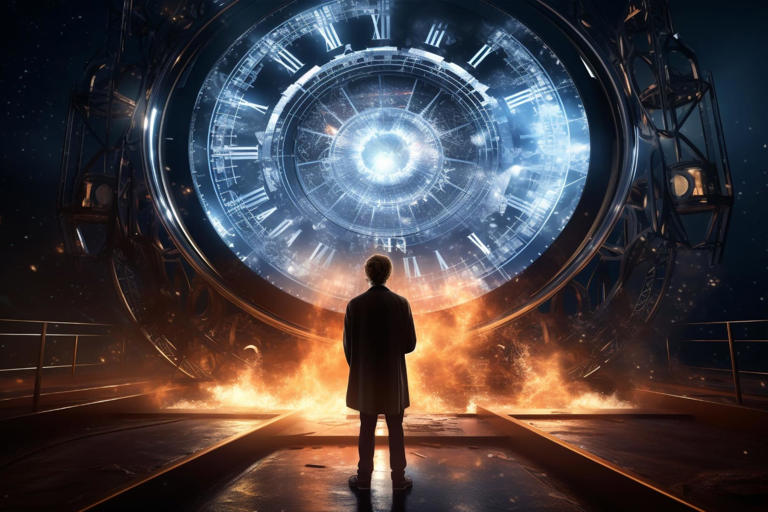
On a cold morning in February, Ethan stepped into a machine that looked like a silver sphere wrapped in glass veins.
Millions watched live.
Parents kept their kids home from school to witness history.
Bars opened early just so people could gather and cheer.
The countdown began:
3…
2…
1…
And then the world changed.
For twelve seconds, the sphere glowed bright white.
Then it dimmed.
Then it opened.
Ethan stepped out.
His face was calm.
His posture relaxed.
Everything looked perfect—except for one thing:
He didn’t recognize anyone.
Not the scientists.
Not the officials.
Not even himself in the mirrors surrounding the exit hallway.
When asked how he felt, he said:
“Who… am I?”
At first, everyone thought it was stress.
A temporary shock.
A side effect like dizziness after anesthesia.
But hours passed.
Then days.
And Ethan remembered nothing.
Not the moment he volunteered.
Not his mother.
Not his childhood.
Not even the English language—he had to relearn it from scratch, like a newborn trapped in a man’s body.
America didn’t know it yet, but this was the first sign of the truth:
Time travel doesn’t just move the body—it wipes the memory clean.
The Discovery That Shook the Nation
The scientists worked desperately.
Brain scans.
Neurology tests.
Electromagnetic analysis.
Eventually, they figured it out:
The human mind was never designed to exist outside its timeline.
Our memories are biological recordings tied to a specific sequence of time.
When time is rearranged, the brain loses its anchor.
Imagine a book where all the pages suddenly scramble themselves.
The story doesn’t just become confusing—
It becomes unreadable.
That’s what happened to Ethan.
That’s what would happen to anyone.
America reacted with a mix of heartbreak and disbelief.
Social media hashtags trended for weeks:
#RememberEthan
#TimeTravelTruth
#ThePriceOfTomorrow
News networks debated endlessly:
Is it ethical?
Is it still worth pursuing?
Should we stop before someone else pays the cost?
But the most haunting question was the one no one wanted to ask out loud:
If you lose your memories, are you still “you”?
Life After Memory: Ethan’s New Reality
Doctors released updates every week, each one more startling than the last.
Ethan had to relearn:
How to eat certain foods
How to tie a shoelace
How to read and write
How to navigate emotions
How to understand humor
How to trust people he didn’t remember loving
His younger sister, Lily, visited him daily.
She once shared something in an interview that made the entire country cry:
“I realized the day he came back… my brother died in that machine.
And a stranger walked out wearing his face.”
Yet she stayed by his side.
She taught him stories about the mother he wanted so badly to see again.
She showed him pictures of old birthdays, old pets, old inside jokes.
He listened with curiosity but never recognition.
For him, those memories were just stories.
For her, they were pieces of a life she was trying desperately to keep alive.
America’s Response: The Hope, the Anger, the Moral Debate
The U.S. divided almost instantly.
Group 1: The Dreamers
These were the people who believed the risk was worth it.
They argued:
-
Memory can be rebuilt
-
This is how breakthroughs happen
-
Every great invention starts with sacrifice
-
Ethan volunteered and knew the risks
Many were grieving people themselves.
They saw time travel as a path to healing—even if the path was risky.
Group 2: The Protectors
These were the people who demanded a shutdown.
-
Too dangerous
-
Too unethical
-
Too unpredictable
To them, memory was sacred.
Identity was sacred.
Humanity was not meant to tamper with time.
Group 3: The Practical Realists
These people wanted regulation, not destruction.
They believed:
“If we can fix the memory-loss problem, time travel could still save millions of lives—accidents, disasters, wrong decisions, medical emergencies.”
Their stance was simple:
Don’t throw away the miracle.
Fix it.
The battle played out in courtrooms, on Capitol Hill, in living rooms, and online.
It was the biggest national argument since self-driving cars and AI privacy laws.
The Hidden Truth: Ethan Was Not the First
Three months after Ethan’s jump, a leaked document shook the nation more than anything else.
Ethan wasn’t the first.
He was the first civilian.
Before him came:
-
2 military volunteers
-
1 federal scientist
-
4 private test subjects funded by corporations
-
1 anonymous donor known only as Patient Zero
Every single one of them lost their memory.
Some couldn’t even relearn how to form sentences.
One still believed it was the year 1989.
Another forgot how to walk.
The government had kept it quiet until Ethan’s results became impossible to hide.
When the truth surfaced, the country erupted.
For the first time, Americans realized:
Time travel didn’t erase time.
It erased people.
The Ethical Question That Will Haunt Us for Years
In the aftermath, a single question became central to every debate, documentary, and late-night conversation:
Is a life without memory still a life?
Some said yes.
Because identity can be rebuilt.
Because humans are resilient.
Because a blank slate is still a slate.
Others said no.
Because memories are the soul.
Because losing your past is losing your self.
Because a body without identity is not a person—it’s a shell.
And then there were those in the middle who echoed the most chilling truth:
If we create time travel knowing it destroys the mind…
Are we no better than the disasters we’re trying to fix?
Ethan’s Final Interview: A Moment That Broke America’s Heart
On the one-year anniversary of his jump, Ethan sat for an interview—his first and only public appearance since the accident.
He looked calm.
Peaceful.
Almost content.
The reporter asked:
“Do you regret volunteering?”
Ethan thought for a long time.
Then he answered softly:
“I don’t remember the man who went in.
But I think…
he must have been very brave.”
America wept.
The question wasn’t about time travel anymore.
It was about what we owe to the people who take risks for progress.
What we owe to those who become collateral damage in the name of innovation.
What we owe to ourselves when our dreams outrun our wisdom.
What This Means for America’s Future
One thing is clear:
Time travel will not disappear.
Humans don’t give up on the impossible.
Not now, not ever.
But the discovery changed everything:
-
Laws were rewritten
-
Ethics boards expanded
-
Mental health teams became mandatory
-
Memory preservation became a new field of science
-
America began asking harder questions about the cost of innovation
Maybe one day, scientists will find a way to protect memories during a jump.
Maybe they won’t.
But society learned something powerful:
Progress is not just about moving forward.
It’s about deciding what part of ourselves we are willing to lose along the way.
FAQs
1. Does time travel always cause memory loss?
According to the findings in this story, yes. The mind cannot survive outside its natural timeline without losing memory.
2. Can memory be restored after time travel?
Not currently. Memories tied to a specific timeline cannot be reattached once disrupted.
3. Why did America take such a big risk?
Because the promise was enormous—correcting mistakes, saving lives, changing the past. Hope is powerful.
4. Could time travel still become safe in the future?
Possibly. Scientists are exploring ways to anchor memories before a jump, but it may take decades.
5. What happened to Ethan after the experiment?
He continued therapy, rebuilt a simple life, and formed new relationships. But his old memories never returned.