Last winter, I was sitting on my couch in my suburban Virginia living room, drinking coffee and scrolling Pinterest, when it hit me — my living room didn’t feel right.
Sure, everything was “fine.” The furniture was nice, the rug was new, and the walls had a fresh coat of beige paint. But somehow, the room felt… off.
Too quiet. Too flat. Too uninviting.
I started thinking about how many of us in the U.S. pour money into our living rooms — big TVs, cozy sectionals, trendy shelves — but still never quite capture that feeling of warmth, balance, and personality we see in magazines or cozy Airbnb listings.
So, over the next few months, I went on a mission — I talked to designers, watched a dozen home makeover shows, visited friends’ houses across states, and most importantly, experimented.
The result? I learned the 10 biggest living room mistakes most Americans make — and how to fix them without spending a fortune.
Let’s walk through them together, like a good friend who’s honest, but also wants your home to feel amazing.
1. The “Everything Against the Wall” Trap
It’s the most common layout mistake in America: every piece of furniture pushed against the walls like they’re allergic to open space.
We do it because it feels like it “opens up the room,” but in reality, it does the opposite — it kills conversation and flow.
When you walk into the room, your couch sits flat against the wall, chairs stare awkwardly at the TV, and the middle feels like an empty dance floor no one’s using.
Fix it: Float your furniture!
Try pulling your sofa even 6–12 inches off the wall and anchoring your seating area with a rug. Create a cozy “conversation zone” with chairs facing each other, not the walls.
If your room is small, opt for slim-profile furniture and nesting tables instead of bulky ones. The goal is connection, not distance.
🪄 Pro tip: In big American open-floor homes, use your rug to visually define the living space from the dining or kitchen area.
2. Poor Lighting — The #1 Mood Killer
Here’s a truth every interior designer knows: lighting makes or breaks a room.
Most American homes rely on a single overhead light — that harsh ceiling fixture that floods everything evenly but lifelessly.
The result? Flat, cold, uninspired spaces that look more like offices than homes.
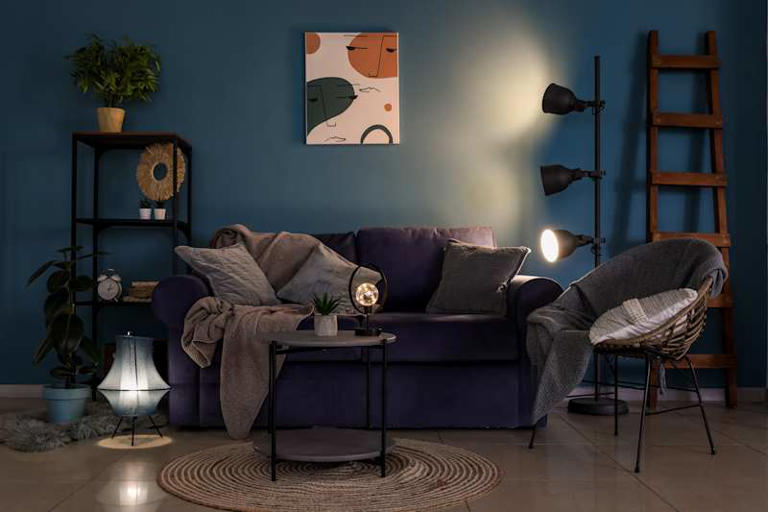
Fix it: Layer your lighting.
Designers recommend three types:
-
Ambient lighting — your ceiling light or chandelier.
-
Task lighting — reading lamps, floor lamps near sofas.
-
Accent lighting — soft glow from wall sconces, string lights, or candles.
Mix warm bulbs (2700–3000K) for a cozy, inviting glow — think golden hour, not hospital hallway.
💡 Bonus tip: Use dimmers or smart bulbs. Adjusting brightness changes the whole vibe instantly.
3. Rugs That Are Way Too Small
This one shocked me once I saw the difference.
Most of us buy rugs that are too tiny for our space — one sad little 5×7 rug under a large sectional, leaving the edges of furniture floating on bare floor.
It makes the room feel smaller and disconnected.
Fix it: Go bigger!
Your rug should anchor the entire seating area. Ideally, all front legs of your furniture sit on it, or even all legs if possible.
In most medium U.S. living rooms, an 8×10 or 9×12 rug works best.
If you’re on a budget, layer a smaller patterned rug over a large, inexpensive jute or sisal rug — stylish and wallet-friendly.
🧶 Pro tip: Rug sizes change the feel: bigger rugs = grounded, unified energy.
4. No Personal Touch — Just “Catalog Energy”
Many American living rooms look great — but they don’t feel like you.
You walk in and see perfectly arranged decor, maybe a big wall mirror and matching throw pillows — but nothing that tells your story.
It’s what I call “catalog energy”: beautiful but soulless.
Fix it: Add pieces that mean something.
Hang framed photos of your travels. Display your grandmother’s vase. Use art from a local market or your kid’s drawings in minimalist frames.
Mix textures, mix memories — a home should feel like a reflection, not a showroom.
🏡 Pro tip: Group personal items in sets of three for visual harmony — a photo, a book, and a small plant make a perfect vignette.
5. Ignoring Curtains — or Hanging Them Wrong
Curtains are often an afterthought, but they dramatically affect a room’s feel.
Many U.S. homes either skip them (just blinds!) or hang them too low and too narrow, making windows look squat.
Fix it: Hang them high and wide.
Install curtain rods about 4–6 inches above the window frame — or even near the ceiling — and extend rods 6–8 inches past each side of the window.
This gives the illusion of taller, wider windows — more light, more elegance.
And choose floor-length curtains (even if your window is small). They add instant coziness.
🎨 Pro tip: Linen or cotton in neutral tones blends with almost any decor and looks timeless.
6. Cluttered Coffee Tables and Surfaces
We all do it — the coffee table becomes a dumping ground for remotes, mail, candles, cups, magazines, and whatever else lands there.
By midweek, it’s chaos.
Clutter creates visual noise that your brain reads as stress.
Fix it: Keep the surface simple and intentional.
Stick to the Rule of 3: something tall (a vase or plant), something low (a tray or book), and something natural (a candle or stone).
Put remotes in a drawer or decorative box.
✨ Pro tip: The fewer things you see, the calmer your living room feels — it’s a psychological truth.
7. Wrong Scale Furniture — Either Too Big or Too Small
American living rooms vary wildly in size — from small apartments in New York to sprawling ranch houses in Texas — but the mistake stays the same: bad proportions.
Either the furniture’s too bulky for the room (making it feel cramped) or too tiny (making it feel awkwardly empty).
Fix it: Measure before you buy!
Your sofa should take up about 2/3 of the wall it sits against. Coffee tables should be half to two-thirds the length of the sofa and sit 18 inches away.
If your space is small, skip giant sectionals. Go modular — a loveseat and a couple of accent chairs create just as much seating but far more balance.
🪑 Pro tip: In big open living rooms, add a console or bookshelf behind the sofa to visually anchor the space.
8. Ignoring Flow — The “Obstacle Course” Room
Ever notice how some rooms feel awkward to walk through?
If you have to sidestep a coffee table or squeeze between chairs to reach the couch — your room lacks flow.
Fix it: Think like a guest.
Walk into your living room as if for the first time. Is there a natural path from the entry to the sofa? To the window?
Leave at least 3 feet of walking space between large pieces of furniture.
Sometimes the fix is as simple as shifting the couch six inches or rotating a chair.
🚶 Pro tip: Symmetry feels good, but comfort feels better — prioritize easy movement.
9. Neglecting Plants and Texture
Many American homes look clean — but sterile. Smooth surfaces, neutral colors, and no life.
You don’t need a jungle, but a few well-placed plants and textured accents can completely shift the mood.
Fix it: Add life in small doses.
-
A fiddle leaf fig or snake plant for height
-
A trailing pothos on a bookshelf
-
A jute rug, woven basket, or chunky knit throw
These layers add visual warmth and a sense of well-being — real, organic, human.
🌿 Pro tip: If you travel often, go low-maintenance — ZZ plants, philodendrons, or faux greenery still do the job beautifully.
10. Forgetting the Power of Scent and Sound
We focus on what we see — but great living rooms appeal to all senses.
When you walk into a cozy American home, you notice not just the furniture — but the soft music, faint candle scent, or gentle hum of a diffuser.
That’s what makes it feel alive.
Fix it: Add sensory layers.
-
Use a scented candle (vanilla, cedar, or citrus) or essential oil diffuser.
-
Play low instrumental music in the background — lo-fi, jazz, or acoustic.
-
Add a soft blanket or throw pillows with varying textures.
It’s about creating a vibe, not a showroom.
🎶 Pro tip: In winter, I play soft crackling “fireplace” sounds on my smart speaker — it tricks my brain into feeling warmer.
The Story of My Living Room (and Maybe Yours)
After making these changes, something remarkable happened.
My living room — the same space, same walls — suddenly felt different.
Friends stayed longer when they visited. My son actually read on the couch instead of escaping to his room. And I started using the space more for morning coffee and evening reflection.
It felt alive, warm, mine.
Because fixing a living room isn’t really about design — it’s about emotion.
It’s about how you feel when you walk into your home after a long day.
Final Thoughts: Your Living Room Should Tell Your Story
If you’re reading this in your Denver apartment, or your Nashville townhouse, or your family home in Wisconsin — know this:
Your living room isn’t just a place to watch TV or host guests. It’s the emotional center of your home.
It’s where life unfolds — the laughter, the arguments, the movie nights, the quiet coffee mornings.
So don’t just decorate it. Design it with heart.
A few tweaks — better lighting, a bigger rug, a few personal touches — can turn your living room from “meh” to magnetic.
And when you finally sit down, cup of coffee in hand, and everything feels balanced — you’ll realize the secret:
You didn’t just fix your room.
You made space for joy.
✅ Quick Recap: 10 Common Living Room Mistakes (and How to Fix Them)
| Mistake | Fix |
|---|---|
| 1. Pushing furniture against walls | Float pieces and create cozy zones |
| 2. Harsh overhead lighting | Layer with floor lamps and warm bulbs |
| 3. Too-small rugs | Size up — anchor all furniture legs |
| 4. No personal touch | Add meaningful decor and memories |
| 5. Wrong curtain placement | Hang high and wide for bigger windows |
| 6. Cluttered surfaces | Simplify with “Rule of 3” styling |
| 7. Furniture out of scale | Measure and balance proportions |
| 8. Bad traffic flow | Maintain 3-foot pathways |
| 9. Lack of texture or greenery | Add plants and tactile elements |
| 10. No sensory atmosphere | Use scent, sound, and warmth |