A Quiet Corner in a Crowded Shelter
It was a chilly fall afternoon in Portland, Oregon. Rain tapped softly against the shelter windows as volunteers hurried about, feeding kittens and cleaning litter boxes. The air was filled with the usual symphony of meows—some curious, some demanding attention.
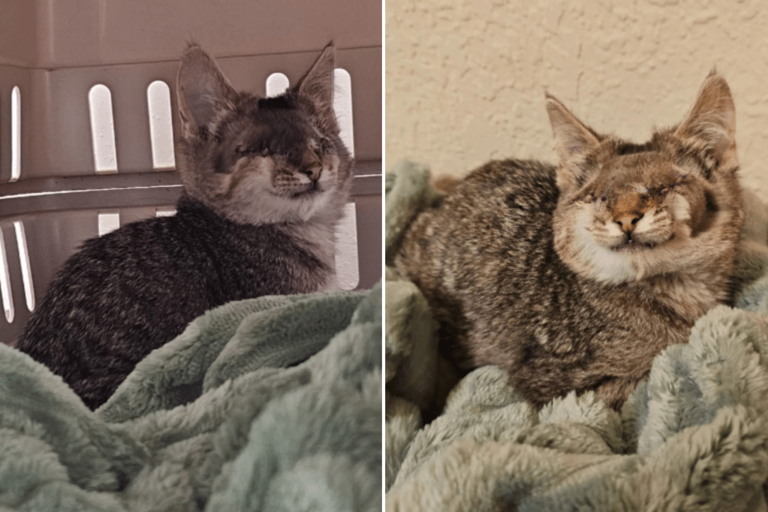
But in the farthest corner of the room, away from the noise and the excitement, sat a small gray cat curled tightly in her bed. She didn’t move much, didn’t cry for attention, and didn’t lock eyes with anyone who passed by—because she couldn’t.
Her name was Luna, and she was completely blind.
Born with a severe eye infection that never healed, Luna had undergone surgery to remove both of her eyes when she was just a few months old. Despite her calm and gentle nature, most visitors to the shelter walked right past her enclosure. They wanted a “playful kitten” or a “friendly lap cat.” Luna, quiet and eyeless, didn’t seem to fit that picture.
Days turned into weeks, and weeks turned into months. Each time someone walked into the shelter, she perked her ears up, sensing the presence of a human—hoping, maybe, that this time someone would stop and see her for who she really was.
But no one did.
Until one day, someone finally did.
The Day Everything Changed
On a Sunday afternoon, a young woman named Hannah Thompson walked into the shelter. She had just moved to Portland for work and was looking for a companion—a small pet to keep her company in her new apartment.
“I was actually planning to adopt a kitten,” she later shared. “But when I walked by the rows of cages, I felt drawn to the corner where Luna was lying. I didn’t even know she had no eyes at first—I just saw this calm, sweet little soul sitting so quietly.”
When the volunteer opened Luna’s enclosure, Hannah knelt down beside her. Luna sniffed the air, then took a few cautious steps forward, her whiskers twitching as she explored Hannah’s hand. Then, slowly, she leaned in and rubbed her tiny head against Hannah’s fingers.
“That was it,” Hannah said. “In that moment, I knew she was mine.”
Luna may not have had eyes, but she saw Hannah in a way that no one else had.
Bringing Luna Home
Adopting a blind cat came with its own learning curve. The shelter gave Hannah a list of tips: don’t move furniture too often, use sound cues to help her navigate, and create safe zones where Luna could rest undisturbed.
On the first night home, Luna explored cautiously. She used her whiskers like radar, moving inch by inch around the apartment. Every sound—the hum of the refrigerator, the creak of the floorboards—was new information to her.
Hannah watched, amazed. Luna bumped into a few things, adjusted, and tried again. Within two days, she had memorized the layout of the entire apartment. She could walk from her food bowl to her favorite window ledge (which Hannah padded with a soft blanket) without hesitation.
“She learned faster than I ever expected,” Hannah said. “It was like she was teaching me that her blindness wasn’t a disability—it was just a different way of experiencing the world.”
A New Life Full of Love (and Mischief)
Luna quickly became the heart of Hannah’s home. She had a habit of following the sound of Hannah’s voice, meowing softly whenever Hannah came back from work, as if to say, “You’re home. I missed you.”
Despite her blindness, Luna’s playful spirit shone through. She learned how to chase toys that made noise—bells, crinkly balls, even a feather wand with a tiny rattle. When Hannah turned on music, Luna would sometimes roll onto her back and paw the air as if she was dancing.
Her favorite game? Hide and seek. Hannah would jingle a toy, hide somewhere in the room, and Luna would track her down—ears flicking, nose twitching, tail held high.
“She never lets her blindness stop her from being curious,” Hannah shared. “She explores every corner. She climbs. She jumps on the couch. She even finds her way to my bed every night and curls up next to me.”
The Story That Touched a Community
When Hannah posted Luna’s story on social media, she wasn’t expecting much. But within days, her post went viral. Thousands of people across the U.S. were moved by Luna’s story—her resilience, her trust, and her joy despite everything she’d been through.
Messages poured in from people who had adopted special-needs animals, sharing their own experiences. “You made me realize I can do it too,” one woman wrote. “I’ve always been afraid to adopt a blind cat, but now I know they can live such happy lives.”
Hannah turned Luna’s story into a small Instagram page called @SeeingWithLuna, where she shares snippets of their life together—Luna playing with her toys, finding sunbeams to nap in, and greeting guests with gentle purrs.
Today, that page has inspired thousands of animal lovers to consider adopting differently-abled pets.
Lessons from a Cat Who Sees with Her Heart
Luna’s story isn’t just about rescue—it’s about perception.
She doesn’t need eyes to see joy. She doesn’t need sight to find love. She lives fully in the moment, reminding everyone that strength isn’t about what you have—it’s about what you choose to give.
Her blindness never stopped her from trusting, exploring, or bonding. And in that way, Luna has taught Hannah—and everyone who follows her journey—what it truly means to see.
Hannah often says, “I thought I was rescuing her, but really, she rescued me.”
Why Special-Needs Cats Like Luna Deserve a Chance
In shelters across the United States, animals like Luna are often the last to be adopted. Many people assume a blind or disabled pet will be too much work or won’t live a happy life. But that’s far from true.
Blind cats rely on their other senses—hearing, smell, and touch—to navigate the world. With patience and love, they adapt beautifully. In fact, most owners report that after a few weeks, their blind cats behave almost exactly like sighted ones.
They play, they cuddle, they form deep emotional bonds. And they teach their humans the power of empathy and unconditional love.
Every time someone opens their heart to a special-needs pet, they change two lives—the animal’s and their own.
Luna’s Favorite Things
Hannah says Luna has a few clear favorites:
-
Sound-based toys: Rattling balls, feather sticks with bells, and crinkle tunnels.
-
Routine: She loves consistency—her food bowl, bed, and toys always in the same place.
-
Snuggles: Luna curls up beside Hannah every evening, purring softly until she falls asleep.
-
Sunbeams: “She can’t see the light, but she definitely feels it,” Hannah laughs. “Every morning, she somehow finds the warmest spot in the house.”
It’s proof that happiness isn’t about perfect circumstances—it’s about finding light, even when you can’t see it.
From Overlooked to Loved Beyond Measure
When people meet Luna now, they often forget she has no eyes. They see her confidence, her calmness, and her warmth. She moves gracefully around her home, jumps onto her favorite window ledge, and greets guests with quiet curiosity.
It’s hard to believe this same cat once sat unnoticed in a shelter, waiting for someone to give her a chance.
And perhaps that’s the most powerful part of Luna’s story—it reminds us that beauty, strength, and love often come wrapped in forms we least expect.
Luna’s Legacy
Today, Luna has become a quiet ambassador for special-needs animals. Her story continues to inspire shelters, adopters, and animal advocates to see beyond appearances.
Hannah volunteers at the same shelter where she found Luna, often helping potential adopters understand that pets like her can live happy, healthy, and deeply fulfilling lives.
“When people meet Luna, they realize she’s not broken,” Hannah says. “She’s just different. And different can be beautiful.”
Final Thoughts: Seeing Beyond Sight
Luna’s journey—from being overlooked in a crowded shelter to becoming the heart of a loving home—is a story about second chances, empathy, and unconditional love.
She can’t see the world the way we do—but she experiences it in a way that’s deeper, purer, and perhaps even more meaningful.
For Hannah, and for everyone who has followed Luna’s story, the lesson is simple:
Sometimes, the ones who can’t see are the ones who help us open our eyes.
FAQs
1. Can blind cats live normal lives?
Yes! Blind cats adapt quickly using their hearing, smell, and whiskers to navigate. They can eat, play, climb, and cuddle just like any other cat.
2. Are blind cats harder to care for?
Not at all. Once they learn their environment, they require very little special care—just consistency and safety.
3. How can you help a blind cat adjust to a new home?
Keep furniture in the same place, create soft paths for walking, and use sound cues like jingling toys or your voice.
4. Do blind cats bond differently with their owners?
Many owners say their blind cats are even more affectionate because they rely on sound and scent to recognize love and safety.
5. What’s the best reason to adopt a special-needs cat?
Because they’ll love you without condition. Their resilience, trust, and gratitude make the bond even more profound.