
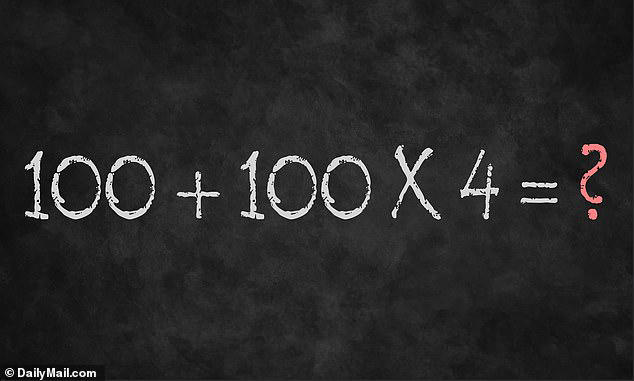
Every few months, the internet finds a new obsession.
Sometimes it’s an optical illusion. Sometimes it’s a brain-bending riddle.
But lately — it’s been a simple math equation.
A math equation so deceptively simple that it’s causing heated debates, broken pencils, and a flood of “Wait, how is that possible?” comments across social media.
It’s not calculus.
It’s not trigonometry.
It’s the kind of problem that looks like something from a 5th-grade textbook — yet even adults, college grads, and engineers are getting it wrong.
The reason?
They’re forgetting one special rule — the same one most of us learned back in school… and promptly forgot.
So, are you ready?
Grab a pen, clear your mind, and set your timer for 30 seconds.
Let’s see if you can solve this viral math mystery before your coffee gets cold. ☕
The Equation That Started It All
It all began when a viral post appeared online asking a seemingly harmless question:
8 ÷ 2(2 + 2) = ?
Looks easy, right?
Most people rush in and say, “Oh, that’s simple! 8 ÷ 2 × (2 + 2)… that’s 8 ÷ 2 × 4…”
And then — chaos.
Half the people confidently answer 1.
The other half say 16.
Both groups swear they’re right.
And the comment section becomes a battlefield of mathematical pride.
So which one is correct?
To find out, we have to dig into that special rule — the one we all learned but rarely apply correctly: the order of operations.
The Forgotten Rule That Changes Everything
If you remember your middle-school math teacher drilling the acronym PEMDAS, you’re already halfway there.
P – Parentheses
E – Exponents
M – Multiplication
D – Division
A – Addition
S – Subtraction
The rule tells us the exact order in which we should solve parts of a math problem — because math isn’t just about numbers, it’s about sequence.
You can’t just go left to right. You have to go in the right order.
Think of it like baking a cake:
You wouldn’t frost it before baking it.
Math is the same way — mess up the order, and the result is a disaster.
Breaking Down the Equation (Step by Step)
Let’s take our problem again:
8 ÷ 2(2 + 2)
Here’s how most people approach it incorrectly:
They go straight left to right —
8 ÷ 2 = 4, then (2 + 2) = 4, and multiply → 4 × 4 = 16
Seems logical… but that’s not how PEMDAS works.
Let’s apply the proper rule:
Step 1: Parentheses first.
(2 + 2) = 4
Now the problem becomes:
8 ÷ 2(4)
Step 2: Handle multiplication and division next — from left to right.
This is where the confusion begins.
Some interpret 2(4) as a single term — 2×4 = 8 — and then do 8 ÷ 8 = 1.
Others treat it left to right: (8 ÷ 2) × 4 = 4 × 4 = 16.
Both methods seem right depending on how you read the equation — but mathematically, the modern interpretation (following conventional notation) treats division and multiplication equally and processes them left to right.
That gives us 16.
But historically?
Older notation — especially before computers — treated parentheses next to a number (like 2(4)) as “stronger” multiplication, implying 1 is correct.
So, technically… both answers have merit.
Wait — So There’s No Single Answer?
Welcome to the beautiful chaos of math notation.
This problem exposes something most people don’t realize: math isn’t just numbers — it’s language.
The way we write equations matters as much as what the numbers say.
Just like punctuation changes a sentence’s meaning (“Let’s eat, Grandma!” vs. “Let’s eat Grandma!”), math symbols control meaning, too.
Without clear brackets, “8 ÷ 2(2 + 2)” can be interpreted differently based on what rules you prioritize.
So while modern textbooks and calculators usually process it as 16, traditionalists — and some older math systems — argue for 1.
The result?
Millions of people arguing online, each armed with their own “proof.”
The Internet Loses Its Mind
In typical American fashion, this problem didn’t stay in classrooms — it went viral.
Teachers started posting explanations on TikTok.
Engineers on Reddit wrote essays.
Parents were texting their kids, “Can you solve this?”
It became more than just math — it became a battle of pride, logic, and nostalgia.
One user wrote, “How can I have a college degree and not solve this?”
Another said, “My 10-year-old just outsmarted me.”
And that’s exactly why this equation captured hearts (and egos) across the U.S.
It reminded us that even something as simple as arithmetic can humble anyone — and that sometimes, the “special rule” we forgot still matters.
Why This Equation Is a Perfect Brain Workout
You might wonder — why does a silly equation like this even matter?
Here’s the truth: puzzles like these actually strengthen your cognitive flexibility.
When you try to solve ambiguous problems, your brain switches gears — using both logic and intuition.
You start recognizing patterns, rules, and exceptions.
That’s the kind of thinking that sharpens your problem-solving skills far beyond math.
It’s the same skill set behind decision-making, coding, and even critical reasoning.
So yes, spending 30 seconds solving 8 ÷ 2(2 + 2) isn’t just a mental game — it’s brain fitness disguised as fun.
The Psychology Behind Why People Get It Wrong
Americans are great at shortcuts.
We love speed — fast food, fast Wi-Fi, fast answers.
That’s exactly why so many people misfire on this equation.
Instead of slowing down and thinking “What’s the rule here?”, our brain defaults to autopilot math.
We see numbers, we calculate quickly — we guess.
It’s called cognitive fluency — the brain’s preference for easy, familiar patterns.
But problems like this trip that system up.
They look easy, but they’re structured to punish overconfidence.
That’s why even smart people can fall into the trap — because the equation plays a psychological trick: it feels simple, but it’s not.
How Americans Learn (and Forget) Math Rules
Ask anyone in the U.S. when they last used “PEMDAS,” and you’ll probably get a laugh.
For most, it was somewhere between middle school and their first job.
We memorize it for tests… then bury it under bills, emails, and Netflix shows.
But equations like this one expose the gap between knowing math and remembering math.
It’s not that people can’t solve it — it’s that they forget how to think like a mathematician.
And that’s exactly why this viral problem hit such a nerve.
It wasn’t about who’s smart — it was about who remembered the rule that started it all.
The Classroom Flashback Moment
If you grew up in the U.S., you probably remember your teacher writing something like this on the board:
12 ÷ 3 × (2 + 4)
Then saying, “Don’t forget PEMDAS!”
Everyone would chant it in unison — like a spell.
But what they didn’t always explain was the nuance — that multiplication and division share the same priority and are solved left to right.
That’s why the internet fight isn’t just about math — it’s about education styles.
For some, PEMDAS was clear.
For others, it was oversimplified.
And now, decades later, that classroom confusion has come back to haunt us — one viral equation at a time.
Math, Miscommunication, and Modern Life
This equation isn’t just a math debate.
It’s a reminder of how easily humans can miscommunicate — even when we’re looking at the same thing.
In America’s fast-paced, digital-first culture, clarity has never been more important.
We misread texts, misunderstand tone, and misinterpret data — just like we misinterpret math symbols.
So, maybe this viral riddle is more than fun — maybe it’s a quiet lesson in slowing down, thinking clearly, and paying attention to the details.
Can You Beat the 30-Second Challenge?
Alright, let’s make it fun.
Grab your phone’s timer, set it for 30 seconds, and try to solve these three equations — without Googling.
-
6 ÷ 2(1 + 2) = ?
-
12 ÷ 4(2 + 1) = ?
-
10 ÷ 5(3 + 2) = ?
If you used PEMDAS correctly and remembered the “special rule,” you’ll get the pattern right away.
But if you guessed based on instinct… you’ll probably see two possible answers pop up.
That’s the beauty of it — your brain is learning, recalibrating, and sharpening with each try.
So What’s the Real Lesson Here?
Math isn’t about getting every answer right — it’s about understanding why the answer is right.
The reason this viral equation became such a phenomenon isn’t because it’s hard.
It’s because it humbles us.
It reminds us that the basics matter — whether it’s math, budgeting, or following a recipe.
The “special rule” we forget isn’t just PEMDAS.
It’s patience.
Slow down.
Think clearly.
Question your assumptions.
That’s the mindset behind every great problem solver — and every person who’s ever figured out something the internet couldn’t agree on.
Final Thoughts: The Equation That United (and Divided) America
At its core, this viral math puzzle is more than a brainteaser — it’s a cultural moment.
In a country where we debate politics, technology, and sports with equal passion, it’s oddly comforting to see millions of people debating… math.
For 30 seconds, people put aside the chaos of the world to solve something pure, logical, and universal.
That’s the beauty of it.
Math doesn’t care who you are, where you live, or what you believe.
It just asks one question:
Can you follow the rule?
So, next time you see 8 ÷ 2(2 + 2) pop up online, smile.
Because whether you get 1 or 16, you’re part of the grandest experiment in curiosity — the human one.
FAQs
Q1: What is the correct answer to 8 ÷ 2(2 + 2)?
The widely accepted modern answer is 16, following standard PEMDAS/BODMAS rules and left-to-right processing of division and multiplication.
Q2: Why do some people say the answer is 1?
Because older notation treated parentheses attached to a number as “implied multiplication,” giving it stronger priority — resulting in 8 ÷ [2(4)] = 1.
Q3: What does PEMDAS stand for again?
Parentheses, Exponents, Multiplication, Division, Addition, Subtraction — the rule for order of operations.
Q4: Is there a difference between PEMDAS and BODMAS?
No, they mean the same thing — BODMAS is just the British version (Brackets, Orders, Division, Multiplication, Addition, Subtraction).
Q5: Why are math problems like this still important?
Because they train critical thinking, problem-solving, and attention to detail — skills that matter far beyond math class.