
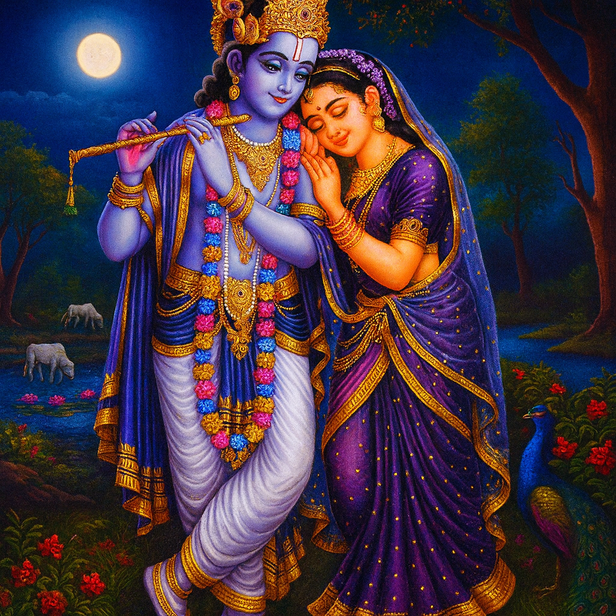
When Silence Speaks: Radha, Longing, and the Sacred Soundlessness of Love
The Sacred Weight of Silence in Hindu Thought
Silence—mauna—is far more than the absence of speech. In the Bhagavad Gita, Lord Krishna reveals, “Among secrets, I am silence.” (Maunam cha eva asmi guhyanām). This is not a casual stillness—it is the divine in hiding, the truth too vast for words to contain. Silence becomes a spiritual posture, a form of tapas—an inner fire refining the mind, as declared in Gita 17.16, where it stands alongside self-restraint and purity as an austerity of thought.
In this view, silence is not a retreat—it is a revelation. It protects the sacred, honors the ineffable, and prepares the seeker for the unseen.
Radha’s Voice: The Sound of Devotion
But what of Radha, whose very soul aches in the moment of viraha—separation from Krishna? When he departs for Mathura, the Bhagavata Purana speaks of the gopis’ sorrow, with Radha at the center—her longing a living fire.
Her pain is not muted. She cries, she calls, she aches aloud. Her tears become sacred syllables. Her despair becomes poetry. Her love speaks—and in that speech, her bhakti deepens. Sorrow turns to yearning, and yearning blossoms into spiritual transcendence. Her voice doesn’t diminish her devotion; it sharpens it like a blade against the stone of suffering.
But What If She Had Chosen Silence?
What if Radha chose mauna? What if she bore her love without a cry, never calling out, never expressing her loss?
Her silence would not be absence, but discipline. It would mirror the path of the mauni yogi—the one who listens not to the world, but to the inner self. Her love would move beyond words, beyond lament, becoming presence itself. Not silence from emptiness, but silence full of divine resonance.
Seen or Unseen: The Dual Faces of Devotion
Radha is not merely a mythic lover—she is Shakti, Krishna’s divine counterpart. The Brahma Vaivarta Purana names her as Prakriti to his Purusha. In this cosmic dance, her love exists whether spoken or silent, manifest or hidden. Her divinity does not depend on expression—it is her essence.
The highest wisdom, say the Upanishads, lies beyond speech. Avyakta—the unmanifest—is the space where Radha’s silence might dwell. A silence that isn’t hollow, but full—so full it spills over into a love that cannot be spoken, only known.
The Fire of Silent Longing
Yet, this silence is not painless. Without expression, longing intensifies. The ache of love deepens when there’s no outlet. But that ache can also become sacred fuel, purifying attachment, dissolving ego, and drawing the soul closer to union.
Pain without words can burn hotter, but it may also shine brighter.
The Risk of Going Unheard
Still, we must ask: what is lost when silence replaces voice?
Radha’s spoken sorrow, her laments and tears, have become songs, scriptures, and solace for generations. If she had remained silent, would her story still reach us? Her voice does not just express love—it teaches it. It comforts the brokenhearted and calls out to the Divine on behalf of all who yearn.
Unspoken love risks invisibility. Without sound, it may go unfelt, unshared. Devotion in silence is potent—but devotion in expression is communal. Radha’s voice bridges hearts across time.
A Love That Dances Between Sound and Stillness
Ultimately, silence and love are not adversaries. They are twin movements in the same sacred rhythm. Choosing silence is not rejecting love—it is embodying it in its most distilled form.
When words collapse under the weight of emotion, silence remains to cradle what cannot be spoken.
When longing takes no shape, silence becomes its outline.
When beauty exceeds description, silence becomes the song.
If Radha ever chose silence, it would not be absence, but presence beyond sound. A love held, not displayed. A prayer heard, not spoken.
Reflect and Listen
In your own journey—have you ever withheld love, choosing silence instead? What did it offer you? What did it cost?
- Can silence be strength—or is it sometimes fear in disguise?
- Can unspoken love still summon the Divine?
- What deserves words, and what deserves quiet reverence?
Radha teaches that both crying out and remaining still are sacred acts. Silence is not superior to speech; it is its complement. In the hush that follows the song, in the stillness that arrives after longing—there too is God.
Radha’s legacy lies not in choosing one over the other, but in holding both. To yearn, and to listen. To speak, and to surrender.