I remember sitting in my freshman chemistry lecture at university in the U.S., watching the professor rotate those sleek, wireframe molecular models under the overhead projector and whispering that someday, we might see molecules do things we once thought impossible. Back then, “breakthrough chemistry” was distant, almost mythical.
Fast forward to today, and the Nobel Prize announcement came like a shockwave through the science community: an Australian professor—Richard Robson of the University of Melbourne—was awarded the Nobel Prize in Chemistry for a discovery that’s already being hailed as transformative. Along with his colleagues, Susumu Kitagawa and Omar Yaghi, Robson’s work on metal-organic frameworks (MOFs) promises to reshape how we store gases, purify water, capture carbon, and more. Information Age+4NobelPrize.org+4ABC+4
To U.S. audiences—students, researchers, curious readers alike—this isn’t just a distant accolade. It’s a powerful reminder of how fundamental scientific curiosity, patience, and decades of persistence can lead to gadgets and solutions that affect everyday life: from cleaner air to safer drinking water.
Let me take you behind the scenes on how a mild-mannered professor became part of a Nobel legacy—and what his discovery means for America and the world.
1. Setting the Stage: The Quiet Scholar
Richard Robson isn’t a household name. He doesn’t stride across media interviews or deliver TED Talks. Instead, he’s long been the kind of scholar who quietly tucks himself into labs, classrooms, and long nights at the bench.
Robson was born in 1937 in Glusburn, England, and later migrated to Australia, where he became a fixture in chemistry at the University of Melbourne. NobelPrize.org+3Wikipedia+3The University of Melbourne+3 He joined Melbourne as a lecturer in 1966 and remained there throughout his career, building a reputation in coordination chemistry—first working on coordination polymers that would eventually evolve into today’s MOF science. scimex.org+4The University of Melbourne+4NobelPrize.org+4
His path was never about chasing headlines. He once admitted that some early critics called his ideas “a whole load of rubbish.” The New Daily But that did not stop him from returning year after year to the same mental models, lectures, and experiments, always refining them, always pushing. The New Daily+2The University of Melbourne+2
It’s essential to remember: Nobel Prizes aren’t always about sudden flashes of brilliance. Often, they’re about long arcs of curiosity—ideas that stick with you for decades until you see how they connect to the future.
2. The Discovery: What Are Metal-Organic Frameworks (MOFs)?
When the Nobel Committee announced the prize, the flashiest phrase floating around was: “rooms for chemistry”. The New Daily+4NobelPrize.org+4ABC+4
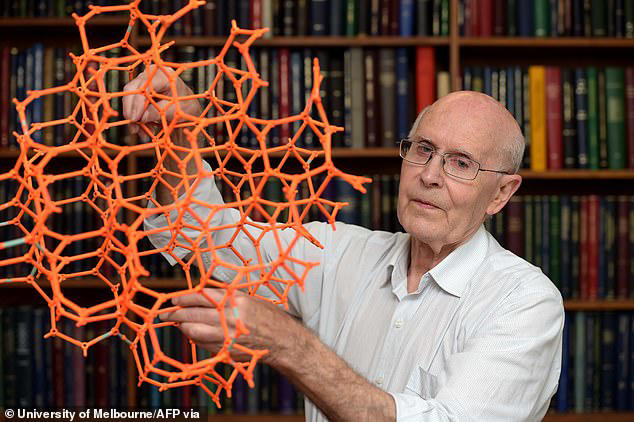
Because that’s essentially what MOFs are: materials constructed by linking metal atoms (or ions) with organic molecules (carbon-based “linkers”) in such a way that the structure contains many voids, cavities, or pores. These internal spaces are not defects; they’re by design. Information Age+4NobelPrize.org+4scimex.org+4
Think of them as microscopic sponges or scaffolding—only far more versatile. By selecting different metals and organic linkers, chemists can “tune” MOFs to capture certain gases (like carbon dioxide), store hydrogen, separate molecules, or even act as catalysts in chemical reactions. The New Daily+5NobelPrize.org+5ABC+5
In the press release, it’s noted:
“In their constructions, metal ions function as cornerstones that are linked by long organic (carbon-based) molecules. Together … form crystals that contain large cavities. These porous materials are called metal-organic frameworks (MOF). By varying the building blocks used in the MOFs, chemists can design them to capture and store specific substances.” NobelPrize.org
To give a sense of scale: a piece of MOF the size of a sugar cube might have internal surface area equivalent to a football field. That’s how porous—and how powerful—these materials can be. The University of Melbourne+4Reuters+4AP News+4
This property—large surface area plus controllable chemistry—makes MOFs especially promising in tackling challenges like gas capture from the air, water harvesting, separating toxins or pollutants, and more.
3. The Three Laureates: Their Roles & Synergies
Because this Nobel is shared, it’s useful to understand how Robson’s contribution intertwined with those of his co-winners: Susumu Kitagawa (Japan) and Omar Yaghi (U.S./Jordan born). Reuters+5NobelPrize.org+5ABC+5
-
Richard Robson: He laid the conceptual and structural groundwork. In the late 1980s, Robson first attempted linking metal centers with organic linkers to produce frameworks. Early versions were unstable, but the idea of coordination polymers and scaffold-like molecular design traces back to him. science.org.au+4NobelPrize.org+4Information Age+4
-
Susumu Kitagawa: He built on Robson’s foundation by demonstrating that gases could flow in and out of these porous structures, and that some MOFs could be flexible or “breathing”—adjusting shape with guest molecules. His work helped show MOFs in operation under real conditions. AP News+5NobelPrize.org+5ABC+5
-
Omar Yaghi: He refined and scaled the design, focusing on stability and modular construction. Yaghi is often credited with turning MOF theory into practical, robust materials by rational design—he likened his work to building with chemical “Lego” blocks. Information Age+5The Guardian+5The Washington Post+5
The Nobel press release highlights how their discoveries, each made independently over decades, “added up” to a new realm of molecular architecture. NobelPrize.org+2ABC+2
Robson’s early experiments had the idea, Kitagawa brought dynamics, Yaghi brought stability and modularity—and together, the result is a flourishing field of thousands of MOF variants being studied today. The New Daily+5NobelPrize.org+5ABC+5
4. The Moment of Recognition & the Human Side
When the announcement came October 8, 2025, it caught many by surprise. Robson, now 88, told journalists he was “very pleased, of course—and a bit stunned.” NobelPrize.org+3ABC+3The University of Melbourne+3 He quipped that handling the attention at his age “might be hard work.”
Yet, mere hours later, he was back at work—teaching a first-year chemistry tutorial. That’s telling of his character: even at the height of global recognition, he stayed true to his passions and responsibilities.
Colleagues described him as humble, methodical, and driven not by fame, but by curiosity. The University of Melbourne’s leadership called his success a tribute to “blue-sky research” and to long-term institutional support for basic science.
One vivid image from media coverage: when asked about how he came up with the MOF idea, Robson recalled that he had built molecular models for lectures, and each time he revisited them, an idea nagged at him — “I ought to follow that up.”
In one article, scientists likened his MOF structures to “Hermione’s handbag” (from Harry Potter)—that magical bag that could hold endlessly while staying compact. The comparison stuck: MOFs can store huge amounts of gases in tiny volumes.
For the U.S. science world—and American readers especially—Robson’s path is a reminder that major breakthroughs often start with teaching models, persistent tinkering, and decades of incremental insights.
5. Why It Matters: Applications & Global Impact
So what does all this molecular geometry mean for society, especially for a country like the U.S., where issues like climate change, water scarcity, and pollution are front and center?
Let’s look at some of the most exciting potential uses:
5.1 Capturing Carbon & Fighting Climate Change
One of the holy grails of modern chemistry is how to catch carbon dioxide (CO₂) effectively, cheaply, and at scale.
MOFs can be engineered to trap CO₂ selectively—potentially enabling better carbon capture in industrial plants, or even capturing atmospheric CO₂ in novel ways.
Given America’s heavy industrial footprint, scaling MOF-based carbon capture could be a tool among many to reduce emissions.
5.2 Harvesting Water from Air
Yes, that sounds like science fiction, but MOFs might make it real. Some MOFs can be tuned to absorb moisture even from dry air, then release it when warmed—making them potential tools for water harvesting in arid regions.
In the U.S., drought-prone states (California, Arizona, the Southwest) are especially hungry for new water technologies.
5.3 Water Purification & Removing PFAS
Per- and polyfluoroalkyl substances (PFAS), sometimes called “forever chemicals,” are persistent pollutants in many U.S. water systems. Some MOFs show promise in selectively filtering or capturing these molecules.
Other potential uses include filtering pharmaceuticals or micro-pollutants from wastewater.
5.4 Gas Storage, Hydrogen, and Energy Applications
MOFs could store hydrogen or methane in compact, safe ways—helpful for future clean energy systems or fuel cells.
They might also act as catalysts—speeding chemical reactions under milder conditions, improving efficiency.
6. Challenges & the Road Ahead
As with any breakthrough, there are obstacles between laboratory promise and real-world deployment. Robson and his co-laureates know this well.
6.1 Stability & Robustness
Early MOF structures were fragile—they collapsed, degraded, or lost functionality under moisture or heat. That’s why later improvements by Kitagawa and Yaghi have been critical: making MOFs that survive real-world conditions.
Scaling these stable versions is still a work in progress.
6.2 Manufacturing & Cost
Producing MOFs at industrial scale—cheaply and reliably—is not trivial. The precision and purity required for their structures demand new manufacturing methods and standards.
6.3 Integration & Lifetime
Putting MOFs into real systems (power plants, water treatment plants, mobile devices) means dealing with interfaces, system stability, cycling (reusing them repeatedly), and degradation over time.
6.4 Regulatory and Safety Concerns
Because MOFs are novel materials, any large-scale deployment must clear environmental, health, and safety assessments. We must ensure they don’t leach damaging substances or behave unpredictably.
Even with these challenges, the Nobel Prize signals that the global scientific community believes in MOFs’ long-term potential. And when institutions like those in the U.S. begin to invest heavily in transitioning lab-grade MOFs to industrial versions, breakthroughs may accelerate.
7. What This Means for American Science, Industry & Students
For the U.S., Robson’s recognition should inspire new energy in materials science, chemistry, clean tech, and national research priorities.
7.1 Renewed Investment in Chemistry & Materials Research
Breakthroughs like these often spark renewed funding from government agencies (e.g., NSF, DOE) and private sectors. America competes globally in clean energy, climate tech, and advanced materials—the MOF field could become a center of innovation.
7.2 Cross-Disciplinary Innovation
MOF research sits at the intersection of chemistry, physics, engineering, and computer modeling. U.S. universities and labs that foster cross-disciplinary work (e.g., MIT, Caltech, national labs) may gain early leadership in MOF-based applications.
7.3 Education & Talent Pipeline
For students in the U.S., Robson’s path is a lesson in patience and passion. He didn’t chase fame; he chased puzzles. American universities might highlight his story to inspire future chemists and materials scientists.
7.4 Localizing Applications
In the U.S., climate, water scarcity, air pollution, and industrial emissions are regional problems. MOF-based technologies might first find traction in places like California’s Central Valley (air quality), the Southwest (water), or around industrial hubs for carbon capture.
7.5 Private Sector Collaboration
Tech companies, energy firms, water utilities, and chemical companies in the U.S. may partner with academic labs to prototype MOF devices. The bridge between discovery and deployment is often built by public-private collaboration.
8. A Personal Reflection for U.S. Readers
Growing up in America, the narrative around chemistry often centered on blockbuster inventions—like plastics, semiconductor materials, or pharmaceuticals. Rarely do we spotlight the slow, methodical breakthroughs — the ones that simmer quietly in university labs until, decades later, they burst into view.
Robson’s recognition reminds us that big things often start small, and even a single person’s curiosity can ripple into global change.
I think about my own students, friends, and the young minds in labs across the U.S.—this is a signal: your work, your midnight equations, your incremental experiments may someday power breakthroughs you can’t yet imagine.
9. Key Takeaways: Is This Just for Scientists?
No. While the story is rooted in chemistry, there are broader lessons any curious reader in the U.S. (or anywhere) can take:
-
Patience and consistency matter — even if your idea seems unpromising at first, keep revisiting it.
-
Fundamental research is essential — today’s “blue-sky idea” might become tomorrow’s essential technology.
-
Breakthroughs are collaborative — Robson didn’t do it alone; later scientists built on his work.
-
Science is global — The Nobel trio represent Australia, Japan, and the U.S. It shows how knowledge transcends borders.
-
We are closer to solutions for climate, water, and pollution than we may realize.
10. What’s Next? A Glimpse Into the Future
As MOF research accelerates, expect several frontiers to open:
-
Pilot plants: Demonstrations of MOF-based carbon capture, water harvesting, and filtration units in U.S. regions.
-
Commercial devices: Portable water harvesters, gas masks, industrial filters, H₂ storage modules.
-
New MOF types: Hybrid MOFs combined with graphene, polymers, or other 2D materials.
-
AI-driven MOF design: Using machine learning to predict which combinations of metal + linker work best for specific tasks.
-
Cross-sector adoption: Energy, environment, pharmaceuticals, defense, and consumer devices might all adopt MOF tech.
For U.S. readers, it means keeping an eye on startups, university spin-offs, federal funding initiatives, and announcements from national laboratories. The day when your water purifier or air filter contains MOFs is no longer science fiction—it’s a next step in the innovation pipeline.
Final Thoughts: The Nobel That Speaks to Humanity
When an Australian professor named Richard Robson — once doubted, working quietly, teaching students until the day after the Nobel announcement — is awarded the highest honor in chemistry, the message is larger than science.
It’s about perseverance, deep curiosity, and believing that small models and thought experiments can bloom into tools for the planet.
For U.S. scientists, engineers, students, and even everyday readers, this story says: invest in curiosity, support basic discovery, and dare to imagine molecules doing the impossible.
Because sometimes, a quiet scholar in Melbourne can spark a revolution that transforms how we breathe, drink, and sustain life on Earth.